5 Lessons From iiTzTimmy's Valorant Lowest To Highest Rank Challenge
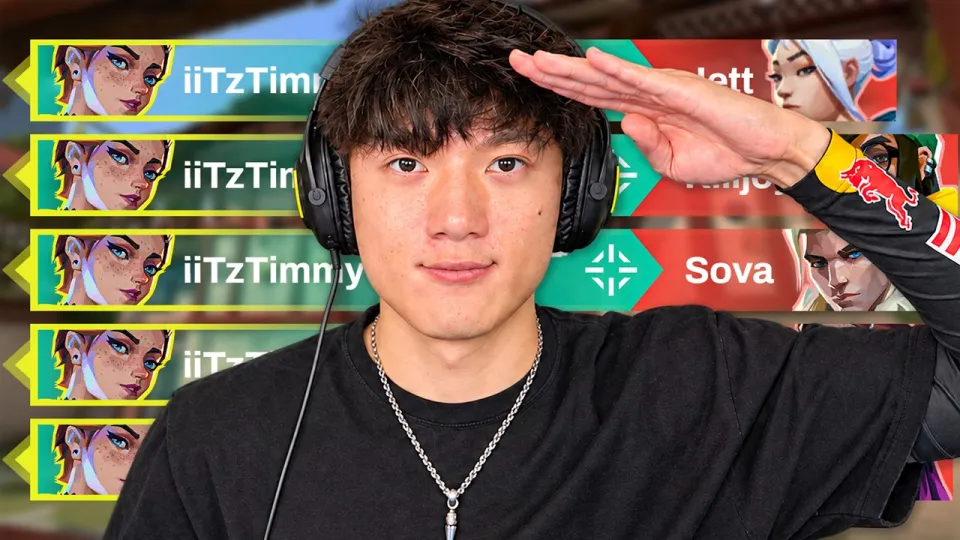
Video: I Might Be Getting TOO Good at Valorant… (Lowest To Highest Rank Challenge)
Want articles like this for your own video to promote it on YouTube and Google? Order them through the Telegram bot @sat_sit_bot. Articles with your video embedded are written and posted by the bot itself — on popular topical sites (no ads). Free trial — 50 articles.
· based on the channel iiTzTimmy Two
Key takeaways
- iiTzTimmy runs the lowest-to-highest rank format in Valorant, starting from the bottom of the ladder and grinding upward on stream.
- The first match turns into a case study in bad team mental: a Cypher flames teammates over comms he never actually received.
- Timmy's answer is to keep taking first contact and entry space instead of arguing back.
- In the second match, opponents chase a famous streamer for clips and lose discipline doing it.
- The full run is streamed live at twitch.tv/iiTzTimmy, where the unedited climb happens.
Valorant is a tactical 5v5 shooter where rank is earned through consistency rather than one hot game, and iiTzTimmy's lowest-to-highest rank challenge shows exactly what separates a climbing player from a stuck one. The format is simple: start at the bottom of the ranked ladder and grind upward until the lobby quality stops being a joke. You can follow the unedited version of that climb live on iiTzTimmy's Twitch channel, where the full stream run happens.
What the lowest-to-highest rank format actually tests
The lowest-to-highest rank challenge is not a aim contest; it is a test of how fast a player can adapt to teammates who do not share their habits. In Valorant, the gap between Iron and Radiant is mostly about information: where enemies come from, when to rotate, and which fights are worth taking. A high-level player dropped into low elo has to unlearn assumptions — nobody holds the angle you expect, nobody trades you on entry, and half the lobby will not use voice chat at all.
That is why the format is more instructive than a highlight reel. Every round exposes a decision that would be punished in Immortal but goes unpunished in Silver, and the player has to decide whether to keep making the correct play or start matching the lobby's chaos. Timmy's approach leans toward the first option: take space, take first contact, and let the scoreboard catch up.
5 lessons the run teaches about climbing in Valorant
- Mental collapses faster than aim. A teammate who spends the buy phase complaining has already lost the round for the team, because nobody is calling rotations anymore.
- Comms you invent are worse than no comms. Assuming a teammate heard a call and acting on that assumption creates the exact failure the player was afraid of.
- Entry pressure still wins low-elo games. Being first onto site forces defenders to react, and reacting players make mistakes that a disciplined attacker can punish.
- Fame changes the lobby. When opponents recognize a streamer, they over-peek for clips, which hands free advantages to the player who stays calm.
- One bad teammate is not a diagnosis. A single tilted player in one match says nothing about the rank; the climb is measured over dozens of games.
Why the tilted Cypher is the most useful part of the video
The first match becomes a lesson in how a team's mental state collapses from the inside. A Cypher player repeatedly blames the team for not hearing information, nitpicks every decision and treats missing comms as proof that everyone else is throwing. The uncomfortable detail is that the information he is angry about was never actually delivered — he is arguing with a version of the round that only exists in his head.
For anyone grinding ranked, that is the recognizable pattern: a player makes a risky solo play, dies, and then reconstructs the round so the fault lands on teammates. The practical fix is boring but effective. If a call matters, repeat it once, clearly, and check that someone acknowledged it. If a teammate is already tilted, stop feeding the argument — every second spent typing is a second not spent holding an angle.
Timmy's response is the opposite of a debate. He keeps entering, keeps taking the first duel, and lets the round result answer the complaint. That is also the healthiest way to handle a lobby where one voice is louder than the rest.
The second match and the thirst for streamer clips
The second game flips the problem. Instead of a teammate melting down, the opponents are the ones off-balance: they recognize a well-known player in the lobby and start chasing individual moments instead of playing the map. Over-aggressive peeks, unnecessary duels and rushed retakes all follow, and a patient attacker collects them one by one.
There is a real lesson buried in the comedy. Players who treat a match as a chance to prove something take worse fights than players who treat it as a puzzle. If you notice yourself hunting a specific opponent for a highlight, that is the moment to reset and play the objective instead. The same principle applies in reverse when you are the one being targeted: let the enemy overextend, then punish the space they leave behind.
Utility details worth stealing for your own games
Small mechanical and utility decisions separate clean rounds from messy ones, and the run is full of them. Sentinels like Cypher reward players who set up before the round starts rather than improvising after contact, and trap placements that cover a rotate path do more work than traps stacked on the main entrance. On attack, the value of a single well-timed piece of utility is that it buys the entry player two or three steps of free space.
The video also underlines how often players misread their own cooldowns. An ultimate that should be online after a kill, a cage that gets called but never placed, a reload started at the wrong moment — these are not highlight-reel errors, but they cost rounds at every rank. Watching your own deaths for utility mistakes is a faster improvement path than grinding aim trainers for another hour.
Common questions from viewers about the challenge
Viewers tend to ask the same practical things after watching a rank climb. The most frequent is about settings: sensitivity and DPI are personal, and copying a pro's number without matching their mousepad space and grip usually makes aim worse, not better. A better method is to pick a sensitivity that lets you turn 180 degrees comfortably and then leave it alone for a month.
The second recurring question is whether a high-rank player actually has to try in low elo. The honest answer is that the mechanics are not the hard part — reading a lobby that does not behave logically is. The third is about the supposedly bugged ultimate moment after a kill; odd interactions do happen, and the useful habit is to check the ability bar instead of assuming it is ready. The fourth is whether the format proves anything about ranked. It does: it shows that consistency, not peak performance, is what moves an account up the ladder.
Useful links
- Watch iiTzTimmy live on Twitch — full streams of the rank climb and other FPS games
- iiTzTimmy on Twitter — schedule and clip posts
- iiTzTimmy on Instagram — behind-the-scenes content
- iiTzTimmy on TikTok — short highlights
- iiTzTimmy Discord — community and announcements
Final takeaway
The lowest-to-highest rank challenge works as a Valorant guide because it removes the excuses: the same player, the same game, different lobbies. What changes between ranks is not raw aim but the quality of information and the discipline to act on it. Keep your comms honest, stop arguing with teammates who have already given up, and treat over-eager opponents as free space rather than threats. This breakdown was put together by the iiTzTimmy Two channel, where the full challenge and similar experiments are published. If you want to see the climb happen without edits, the live stream at https://www.twitch.tv/iiTzTimmy is the place to start.
Questions & answers
What is the lowest to highest rank challenge in Valorant?
It is a format where a strong player starts at the bottom of the ranked ladder and grinds upward, usually on a fresh or low-ranked account. The point is to show how decision-making changes as opponents get better. iiTzTimmy runs this format on stream, and the edited version appears on his second YouTube channel.
Do you need Radiant-level aim to climb out of low elo?
No. Low-elo lobbies rarely punish small aim errors, but they do punish bad positioning and wasted utility. Taking space early, trading teammates and keeping comms simple matter more than raw flick speed until you reach the higher ranks.
How should you handle a teammate who blames the team constantly?
Give the important call once, clearly, and move on. Arguing costs you the buy phase and distracts the players who are still trying. Mute if the voice chat becomes noise, and let your own rounds do the talking.
Why do opponents play worse when they recognize a streamer in the lobby?
They start chasing individual moments for clips instead of playing the map, which leads to over-peeks and rushed retakes. A patient player can punish that impatience by holding angles and letting the enemy come to them.
Source: I Might Be Getting TOO Good at Valorant… (Lowest To Highest Rank Challenge) · Markdown version